
Every year on 23rd of September, the world marks the International Day of Sign Languages, proposed by the World Federation of the Deaf (WFD) and adopted by the UN General Assembly in December 2017. However, the official launch took place in 2018. Since then, schools, governments and organisations around the world have consistently embraced the celebration, creating a lasting impact that continues to grow today. It is also worth noting that this day falls during the International Week of the Deaf, a week-long celebration that gives voice to the Deaf communities and celebrates their rights and culture all around the world.
Looking back at the History, the World Federation of the Deaf was founded on September 23rd, 1951 and decades later, the same date was chosen to celebrate the International Day of Sign Languages. The primary Goal of the UN in creating this day was to support and protect the rights of Deaf people. This day encourages people all over the world to reflect on how communication can look for those who use Sign Languages in their everyday lives.
It’s a call to understand and learn about Deaf culture, embrace it and give it the value it deserves. This day also marks an opportunity to remind us that everyday spaces such as schools, hospitals, workplaces, government offices, shopping malls and other public places should be just as accessible to Deaf people as they are to everyone else. A Deaf person should be able to walk into these spaces and get help easily. Workplaces can do their part by hiring interpreters or staff trained in Sign languages. Malls and stores can do the same, so Deaf customers don’t struggle with simple day-to -day activities. Similarly, schools and universities have a role to play too, by adjusting their courses and facilities so that Deaf students can learn comfortably without any extra barrier standing in their way, just as the other students do. As a result, eventually the gap between the Deaf and Hearing communities shall vanish.
The World Federation of the Deaf reports that there are more than 70 million Deaf people worldwide who rely on Sign language as their main way of communicating and more than 80% of them live in developing countries. Sign language isn’t one language and there is no universal version that every Deaf person everywhere understands. Collectively, more than 300 different Sign languages are used worldwide and each language has its own rhythm, culture and grammar embedded in it.
” International Sign”, which evolved from the 1973 system known as “Gestuno”, is used by Deaf people at International meetings and conferences as a common means of communication across different national Sign languages. Looking at the present, the theme for the International Day of Sign Languages 2026 is “Declaring Deaf people’s Human Rights.” This highlights that communication is not merely a feature or accommodation added to their lives, but a core responsibility and a basic human right that must be upheld.
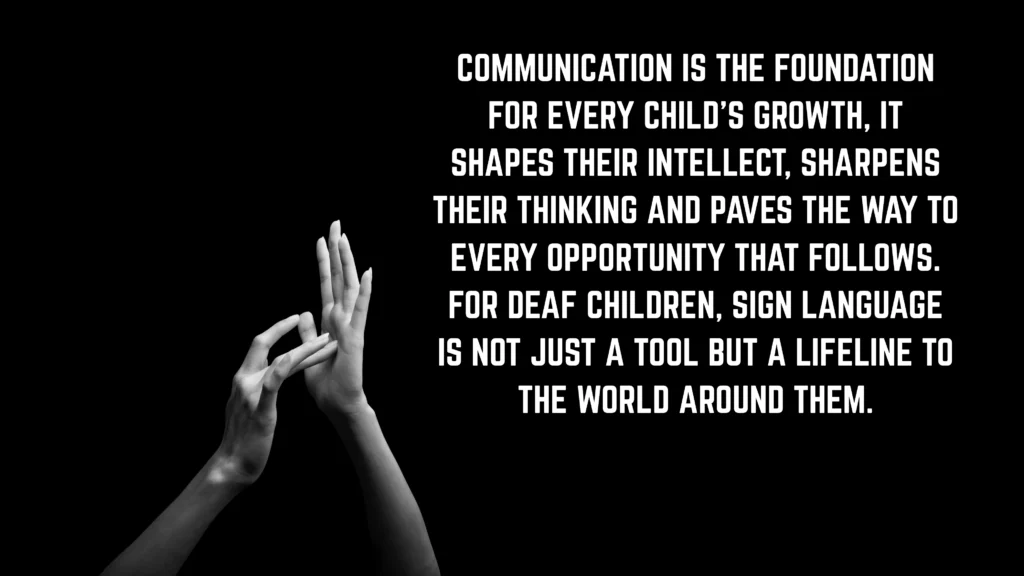
In the end, Communication is the foundation for every child’s growth, it shapes their intellect, sharpens their thinking and paves the way to every opportunity that follows. For Deaf children, Sign language is not just a tool but a lifeline to the world around them. As we commemorate the International Day of Sign Languages, let us remind ourselves to always stand by the Deaf community and help them thrive.
Written By: –

Rtr. Sumaiya Waiss
(Junior Blog Team Member 2026-27)