
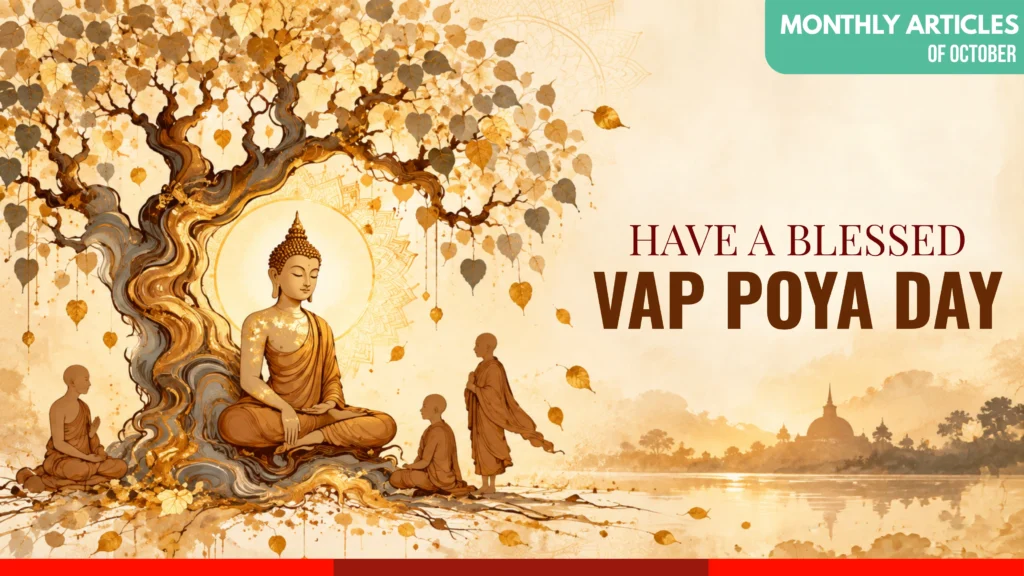
Vap Full Moon Poya Day or Vap Poya is one of the most important Full Moon Poya Days celebrated by Buddhists in Sri Lanka. The day falls in October and carries a lot of religious significance in the Buddhist faith. The day gives Buddhists an opportunity to consider the teachings of Buddha, observe the practice of generosity, enhance their morality and spiritual insight.
One of the most important events during the celebration of Vap Poya is the end of the Buddhist rainy season, which marks the completion of the rainy retreat. During the rainy period, Buddhist monks stay in one place and focus on meditation, studying the Dhamma and other religious activities. During this period, the Katina ceremony can take place. Offering of the Katina robe is a very meritorious act as devotees come together and give their tribute to the Sangha.
It should also be noted that Vap Poya is related to an event in the life of Arahant Mahinda Thera, who brought Buddhism to Sri Lanka. It is believed that after staying in Sri Lanka for some time, Arahant Mahinda Thera observed the Buddhist retreat during the rainy season in Mihintale. This means that Vap Poya holds historical significance when it comes to the history of Buddhism in Sri Lanka.
One more interesting feature about Vap Poya relates to the practice of religion and personal reflection. On this day, devotees attend temples, take part in Sil observance, attend meditation courses, hear sermons, perform Bodhi Pooja and make offerings to the monks. In this way, it becomes possible to concentrate on developing good thoughts and behavior.
The doctrines of Buddhism advocate for traits like compassion, loving kindness, patience, generosity, mindfulness and wisdom. In this regard, Vap Poya can be regarded as not only a religious practice but also an occasion where one can think about how these values can be practiced in one’s daily life through helping others, speaking kindly, refraining from any form of hurting others and developing consciousness of one’s actions.
The custom of the Katina ceremony also emphasizes the need for communal participation since the devotees join hands to conduct religious activities and offer things. Through this process, they not only develop their communal relationships but also learn the value of simplicity and gratitude.
As far as the changing modern society is concerned, the value of Poya Days lies in much more than religion. Poya Days offer useful occasions to people to stop and think about certain principles which lead to happiness and ethical living in society.
This particular event is hence a good time to reinforce faith, give alms, cultivate mindfulness and contemplate the Dhamma. With the proper appreciation of the significance of the observance, the faithful will be able to make use of the day to grow both personally and spiritually without sacrificing their Buddhist traditions.
Written By: –

Rtr. Nimmi Maheeshi
(Junior Blog Team Member 2026-27)