
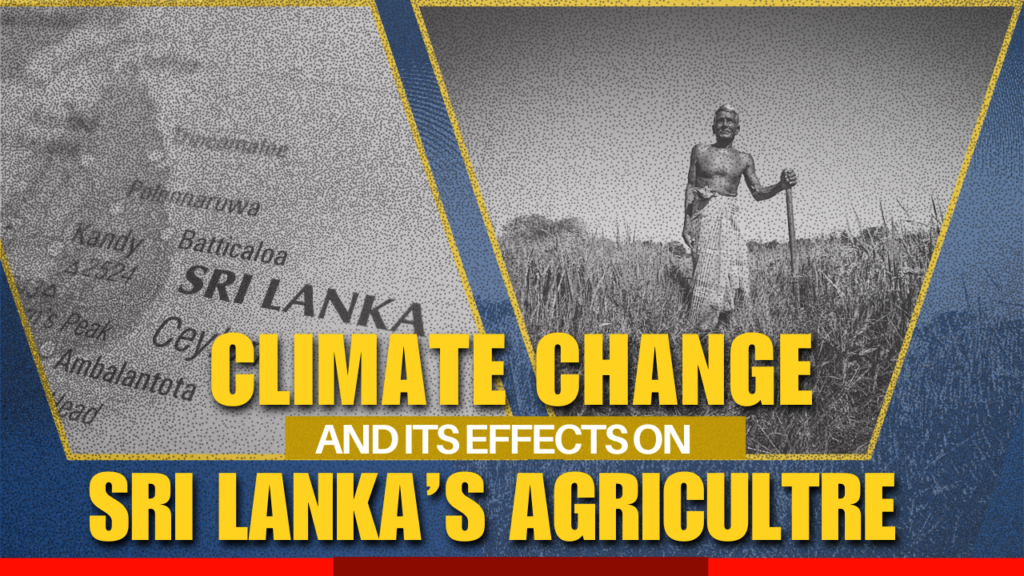
Sri Lanka’s agricultural sector is vital to the stability of the country as it not only contributes to GDP but also to the country’s employment levels. The industry is dependent on a large number of small-scale farmers.
Before we get into how climate change affects our country’s agriculture, let’s look at what climate change is.
The UN briefly describes climate change as “long-term shifts in temperatures and weather patterns.” It’s easy to confuse global warming with climate change. However, global warming is the increase in Earth’s global temperature, and it is a component of climate change. Climate change includes other changes such as sea level rise, atmospheric CO2 changes, etc.
Now, let’s look at the general effects climate change has on our country.
Temperature changes, natural disasters, sea level rises, negative impacts on ecosystems and humans, including their livelihoods, are the major types of effects climate change has on our country. It’s important to note that the recent cyclone Ditwah was caused as a result of climate change. It’s time to realise that climate change is not some “hoax” or “conspiracy” but something that is very real and threatening all of us and our loved ones.
Sri Lanka is vulnerable to climate change’s effects because of not only its geographic location but also its socio-economic status. The ministry has admitted several times that it was “not prepared for disaster”. In recent years, Sri Lanka has faced an increased possibility of facing tsunamis, cyclones and floods. These events can do immeasurable damage to the country’s agriculture.
It’s important to note that it’s not just floods and droughts that will harm the country’s agricultural sector, but also the above-mentioned changes in temperature, rainfall and humidity. These unpredictable changes can also bring forth diseases and pests.
According to the chairman of the National Steering Committee on Climate Change Adaptation: “The first and foremost impact of climate change on agriculture is reduced yield caused by drought conditions, flood conditions, temperature stress, pests and diseases, and reduced soil fertility.”
Once crops are damaged by floods or droughts, naturally, the market prices for those would go up due to the food scarcity. When livestock such as cattle or chickens is destroyed, the government will have to work to fund these farmers. Not to mention, it also increases the chances of contaminated foods entering the markets. Such disasters are not only threatening food security but also undermining the stability of rural economies and exacerbating poverty (Aheeyar et al., 2021).
Let’s take a look at just the effects of the recent floods caused by Cyclone Ditwah, according to the Tamil Guardian. The country has requested urgent funding, of which 15 billion alone was to restore paddy and vegetable crops and lands, while 900 million was to rebuild anicuts, which are a crucial infrastructure for the country’s infrastructure and another 10 billion for damaged irrigation systems and canals. That’s a total of nearly 26 billion just to restore the damages done to the agricultural sector by Cyclone Ditwah.
That was only the destruction in terms of funds. Around 510,000 hectares of rice fields had been destroyed. That’s nearly the size of over 200,000 American football fields!
Moreover, a total of 26,012 livestock, cows, sheep and chickens have also been killed.
Imagine if one cyclone was enough to bring forth this much carnage to our already vulnerable country, how much more can we really withstand?
Hence, it’s necessary for Sri Lanka to take necessary steps to adapt to a climate-resilient agricultural sector, focusing on preparedness, sustainability and implementing other necessary strategies to drive the agricultural sector towards a more climate-smart existence. Further, Sri Lanka’s National Policy on Climate Change was revised in 2023 as opposed to the old National Climate Change Policy of 2012.
And you, dear reader, has a responsibility not only as an individual but also as a collective to take action and prevent and minimise the effects of climate change to save our homeland and protect it.
Written & Design By: –

Rtr. Kawindra Wickramasinghe
(Junior Blog Team Member 2025-26)