
We tend to notice things that are loud. Things that grow fast, shine brightly, or demand attention. Quiet strength often slips past us. We walk by it, live around it, and only much later realize it was always there, holding everything together in its own steady way. That kind of strength feels deeply human. It is in the way people continue after difficult days. It is in the way life moves forward without needing recognition. It is not dramatic, but it lasts.
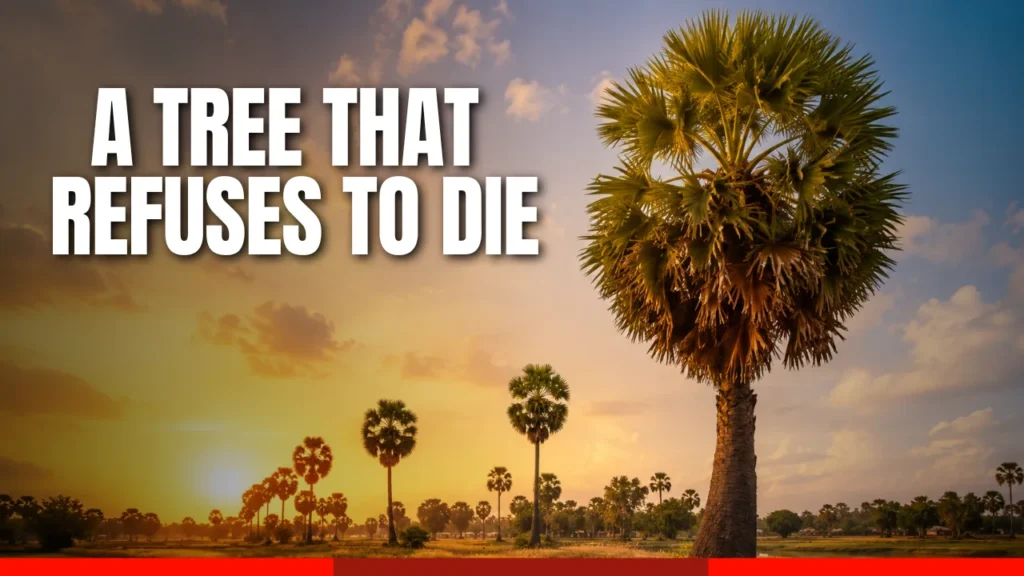
In the north of Sri Lanka, this quiet strength takes a visible form. The palmyrah tree stands across the landscape of Jaffna, tall and unassuming. Known scientifically as Borassus flabellifer, it is one of the most distinctive trees in the region and is often referred to as the lifeline of the northern dry zone. It does not try to impress. Its trunk rises straight, sometimes reaching heights of over 20 to 30 meters, with a crown of fan shaped leaves that can span wide enough to catch even the slightest breeze. Yet there is something about it that feels grounded, almost familiar, as if it understands endurance in a way words cannot explain.
The land it grows in is not easy. Jaffna lies within Sri Lanka’s dry zone, where rainfall is seasonal and often unpredictable. The soil can be sandy and low in nutrients, and temperatures remain high for most of the year. Many plants struggle under such conditions. The palmyrah does not. Its deep root system allows it to access underground water, making it highly drought tolerant. It grows anyway. Slowly, patiently, without urgency. In fact, a palmyrah tree can take more than a decade to mature, but once established, it can live for over a hundred years.
There is something quietly comforting in that. The tree does not fight to survive in ways we can see. It simply continues. Day after day, season after season. Its growth is not rushed, and yet it is certain. Over time, it becomes strong enough to withstand strong winds and long dry periods. Even when other vegetation fades, the palmyrah remains standing, unchanged in its quiet persistence.
For the people of Jaffna, the palmyrah is not just part of the scenery. It is part of life itself. It is often called a tree with a thousand uses, and that is not an exaggeration. The fruit, known locally as nungu or ice apple, is consumed fresh and is valued for its cooling properties in hot climates. The pulp is used in traditional sweets and dishes. The sap, tapped from the flower, is used to produce jaggery, treacle, and toddy. The leaves are dried and woven into mats, baskets, roofing, and even used historically as writing material for manuscripts. The timber from its trunk is durable and resistant to pests, making it useful for construction.
This connection goes beyond practicality. The palmyrah is deeply embedded in the cultural and economic identity of northern Sri Lanka. It has been a source of livelihood for many families for generations. In fact, it is recognized as a national symbol of resilience and is even associated with regional pride in Jaffna. Various local industries, including handicrafts and food production, continue to depend on it.
The tree has also played a role in history. During times of hardship, including periods of conflict and economic difficulty, the palmyrah provided essential resources when other supplies were limited. It stood as a reliable source of food and material, reinforcing its image as a tree that sustains life even in the most uncertain times.
There is also a certain dignity in the way it stands. It does not spread wide or compete for space. It grows upward, focused and calm. Even when it stands alone, it does not feel incomplete. Itsrough trunk often carries marks of age, yet it remains firm, holding its place with a quiet confidence that does not need to be proven.
In many ways, the palmyrah reflects something we recognize in ourselves. The ability to keep going without always knowing how. The ability to adapt without losing who we are. The strength to stand, even when the conditions are not ideal.
It does not offer lessons loudly, but they are there for anyone who chooses to see. It reminds us that growth does not need to be fast to be meaningful. That survival is not always about resistance, but sometimes about acceptance and persistence.
The palmyrah tree of Jaffna is more than a part of the land. It is a presence that quietly shapes the way the land feels. It stands without asking to be noticed, yet once seen, it is hard to forget.
Perhaps that is why it is often thought of as a tree that refuses to die. Not because it is untouched by hardship, but because it continues, rooted deeply in both the earth and the lives of those around it.
Written By: –

Abinya Subramaniam
( University of Moratuwa)