
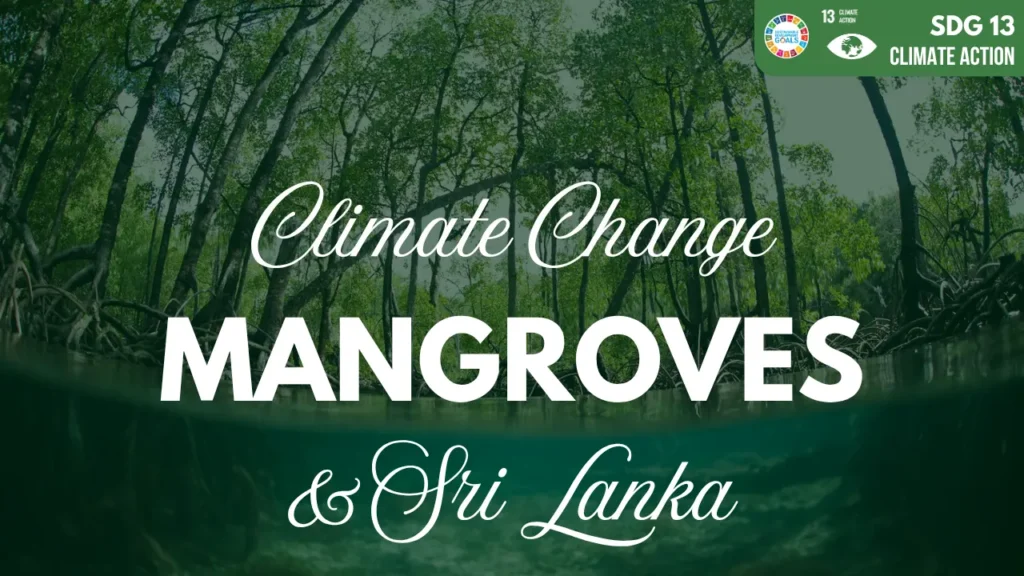
Mangroves, commonly known as “Kadolana” in Sinhala, are a group of trees and shrubs that grow along the meeting point of land and sea, particularly in coastal areas where saltwater and freshwater mix. Although they may not look as impressive as the massive rainforests we often associate with climate change, these small coastal forests are some of nature’s most powerful climate warriors.
Mangroves are found across tropical and subtropical coastlines around the world, with dozens of different species adapted to survive in salty and constantly changing environments. Their tangled roots provide shelter for fish, crabs, birds and many other species, making mangrove ecosystems an important part of marine biodiversity.
But their importance does not stop there.
The Blue Carbon Warriors
Ever heard of blue carbon?
Blue carbon refers to the carbon captured and stored by coastal and marine ecosystems such as mangroves, seagrass meadows and salt marshes. Mangroves are particularly impressive carbon stores, with their soils and biomass capable of holding enormous amounts of carbon. In fact, mangrove ecosystems can store several times more carbon per area than many tropical forests on land.
This means that protecting a mangrove forest is not simply about protecting a few trees. It is also about keeping the carbon already stored within those ecosystems locked away. When mangroves are destroyed or degraded, much of that stored carbon can be released back into the atmosphere, contributing to the very climate crisis we are trying to fight.
They’re More Than Just Trees!
Mangroves are also nature’s very own coastal shields.
Their complex root systems and dense vegetation help reduce the force of waves, storm surges, erosion and flooding, protecting coastal communities from some of the impacts of extreme weather.
For an island nation like Sri Lanka, surrounded by the Indian Ocean, this protection is especially important.
Mangroves and Sri Lanka
Sri Lanka is home to a diverse range of mangrove species spread across its lagoons, estuaries and coastal wetlands. The Puttalam Lagoon, in particular, contains some of the country’s most extensive mangrove ecosystems.
Yet, despite their importance, Sri Lanka’s mangroves have faced significant pressure over the years from activities such as aquaculture, coastal development, pollution and the conversion of mangrove areas for other uses. The consequences of losing them extend far beyond losing a few patches of greenery.
The 2004 Indian Ocean tsunami demonstrated just how important coastal ecosystems can be in protecting communities. Mangrove areas can act as natural barriers against powerful waves and storm surges, helping reduce the vulnerability of coastal communities.
Mangroves & SDG 13: Climate Action
This brings us to Sustainable Development Goal 13 – Climate Action.
SDG 13 calls for urgent action to combat climate change and its impacts. Among its targets are strengthening resilience to climate-related hazards and increasing education and awareness about climate change.
Protecting mangroves directly contributes to these goals. They store carbon, support biodiversity, protect coastlines and help communities adapt to the impacts of a changing climate. In other words, mangroves are not simply part of the solution to climate change; they are also part of the solution to living with the climate change that is already happening.
It is easy to think that climate action means massive solar farms, electric vehicles or international climate conferences. But sometimes, climate action can be as simple as protecting a forest growing quietly along our coastline.
Sri Lanka’s mangroves are more than just trees growing in muddy water. They are carbon stores, coastal shields, homes for wildlife and protectors of our communities.
Therefore, protecting them is not only about conserving our natural heritage. It is an investment in our future.
Because when we protect our mangroves, we protect our oceans, our communities, our climate and ultimately, ourselves.
Written By: –

Rtr. Kawindra Wickramasinghe
(Co Editor 2026-27)