
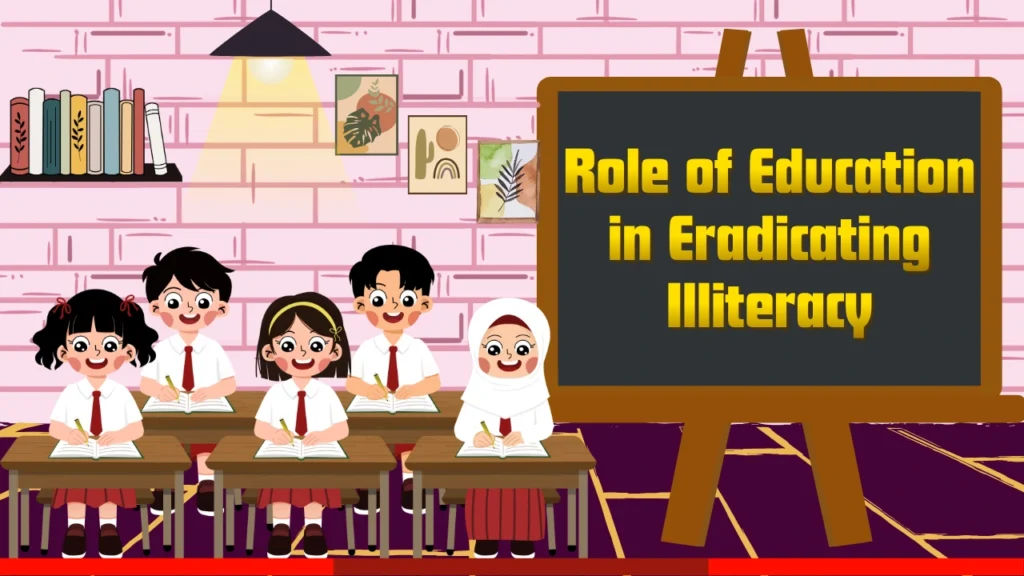
Illiteracy is often described as an invisible wall: one that silently limits a person’s choices, freedoms and opportunities. But throughout history, education has proven to be the tool that breaks this wall brick by brick. As the saying goes, “Knowledge is power,” nowhere is this more evident than in the fight to eradicate illiteracy. Education does more than teach letters and numbers, it gives people the ability to participate fully in society, make informed decisions and shape their own futures. In a world where accessing information is essential for everything from employment to health literacy is not a luxury. It is a fundamental human right, recognized and reaffirmed by global organizations and education advocates across the world.
The global movement towards quality education for all makes one thing clear: universal literacy begins with free, accessible and inclusive schooling. When governments commit to providing compulsory basic education, they create a pathway out of inherited disadvantage. Studies and resolutions from education bodies stress that eradicating illiteracy depends not only on getting children into classrooms but ensuring that those classrooms offer trained teachers, supportive environments and an education that truly equips learners for life. The early years matter profoundly as children who receive early education build stronger literacy foundations, setting them up for long-term success.
However, addressing childhood education alone does not complete the picture. Millions of adults around the world never had the chance to attend school. For them, illiteracy limits daily life in ways many take for granted such as reading a medicine label, signing a document or helping a child with homework. This is why adult education and lifelong learning are essential pillars in the journey toward a literate world as without it, the world turn into a case of the “The blind leading the blind” as a guide cannot lead the way if they themselves cannot see the path. Adult literacy programs give people a second chance, not only to learn reading and writing, but to participate confidently in society.
The ripple effects of literacy reach far beyond the individual. A literate society is a healthier, more stable and more economically capable one. Research shows that literacy opens pathways to better jobs, informed financial decisions, and stronger civic engagement. The impact is especially profound for women: when women become literate, families thrive—children’s health improves, maternal mortality drops, and entire communities become more resilient. Education advocates often echo the wisdom of the well-known proverb: “Give a person a fish and you feed them for a day; teach a person to fish and you feed them for a lifetime.” Literacy is the ultimate form of teaching someone to “fish” , a lifelong skill that unlocks self-reliance.
Nowhere is the power of education to break the cycle of illiteracy more evident than in the lives of women. For generations, women have had to fight for the simple right to learn, their access to education held back by poverty, early marriage, and traditions that valued their silence over their potential, even now women still make up nearly two-thirds of the world’s illiterate adults. In places where girls are pulled from classrooms before they can truly begin, their lives often become shaped by others’ decisions, their dreams dimmed by social norms never designed for their freedom. Yet when a girl is given the chance to learn, the transformation is profound: educated mothers save more children’s lives, and each additional year of schooling has been shown to sharply reduce child mortality. Education becomes a woman’s quiet revolution empowering her to earn, to speak, to participate, to know her rights and to seek justice without being taken advantage of.
Modern literacy extends beyond reading and writing. In a fast-changing world, individuals need digital literacy, critical thinking, numeracy, and media awareness to navigate daily life. Programmes today emphasize this broader definition, ensuring that education prepares people for modern challenges. With technology reshaping every aspect of society, the ability to learn continuously has never been more vital. Education systems worldwide are increasingly urged to adapt, ensuring that learning keeps pace with the realities of an evolving world.
Illiteracy may be one of humanity’s oldest challenges, but education remains one of our strongest solutions. When people gain the ability to read and write, they gain the power to understand their world, protect their rights, and shape their own destinies. With every classroom built, every teacher trained, every adult empowered to learn, we move closer to a world where illiteracy is not an unavoidable fate but a solvable problem. And in that world, the simple act of learning becomes the spark that lights the way forward for individuals, families, and generations to come.
Written By: –

Rtr. Lakshini Haturusinghe
(Senior Blog Team Member 2025-26)
Design By: –

Rtr. Nethmini Pathirana
(Junior Blog Team Member 2025-26)