

Introduction
Sri Lanka features a uniquely rich legal system operating on a pluralistic framework. It integrates English Common Law principles, Roman-Dutch civil law and personal or customary laws such as Kandyan Law, Thesawalamai and Muslim Law. Established under the Constitution and the Judicature Act No. 2 of 1978, the judicial branch functions as an independent pillar responsible for maintaining the rule of law, protecting fundamental rights and administering civil and criminal justice across the island.
The Judicial Hierarchy of Sri Lanka
The court system is organised into a clear hierarchy, dividing responsibilities between appellate courts and courts of first instance (trial courts):
- The Supreme Court: The apex court and final court of appeal in Sri Lanka, chaired by the Chief Justice. It holds exclusive jurisdiction over constitutional interpretation, fundamental rights applications, presidential election petitions and the enrollment or discipline of attorneys-at-law.
- The Court of Appeal: The primary appellate court exercising jurisdiction over lower trial courts. It possesses significant authority to issue prerogative writs (such as certiorari, mandamus, prohibition and habeas corpus) to correct legal or procedural errors.
- The High Court: The only court in Sri Lanka that exercises both original criminal jurisdiction and appellate civil jurisdiction. It handles grave indictable offences (such as murder or treason) through High Court trials (including High Courts at Bar). Provincial High Courts also hear civil appeals originating from lower trial courts.
- District Courts: Primary courts of original civil jurisdiction. They adjudicate commercial disputes, land and property litigation, family law and contract claims.
- Magistrate’s Courts: Primary courts of original criminal jurisdiction handling minor to moderate summary offences, initial bail proceedings and statutory inquiries.
- Specialised Tribunals & Primary Forums: Includes Labour Tribunals, Mediation Boards and specialised administrative bodies designed to settle specific labour, community, or small claims disputes.
Internal Limitations and Structural Challenges
While the judiciary serves as a cornerstone of Sri Lankan democracy, it faces a series of internal administrative and operational limitations:
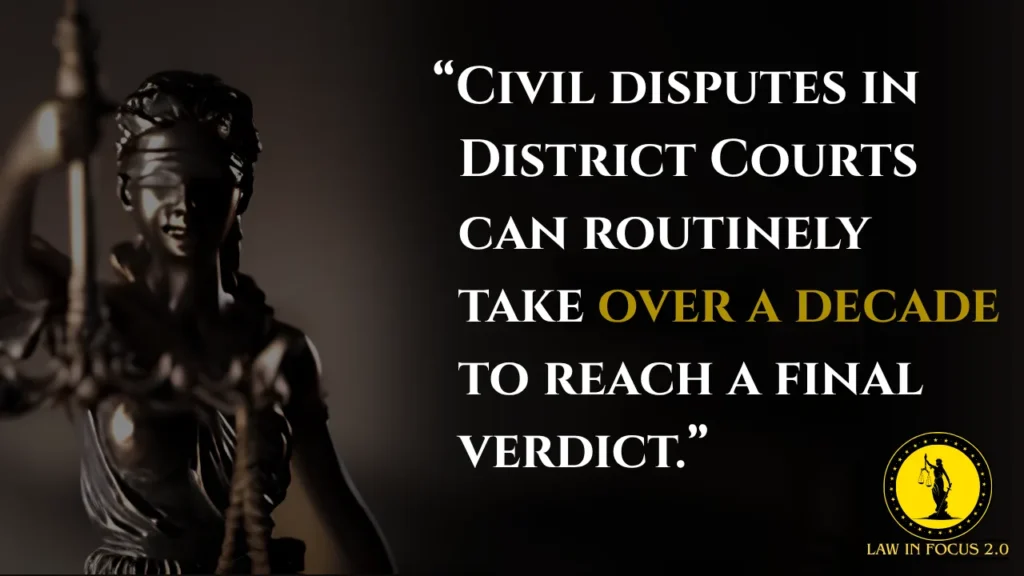
- Systemic Case Backlogs: One of the most significant hurdles is severe court congestion, with over one million cases pending across various levels of the judiciary. Civil disputes in District Courts can routinely take over a decade to reach a final verdict.
- Procedural and Capacity Bottlenecks: Delays are further compounded by manual recordkeeping practices, frequent trial adjournments and heavy case loads borne by the state apparatus such as understaffing in the Attorney General’s Department, which slows the drafting and serving of indictments.
- Paper Based Operations: The trial court system continues to rely heavily on physical documentation, manual docket management and mandatory physical appearances, which limits administrative efficiency and increases costs for litigants.
- Constitutional Boundaries on Judicial Scrutiny: Under Article 80(3) of the 1978 Constitution, the judiciary’s power to review legislation is restricted to pre-enactment scrutiny of Bills. Once a Bill is passed by Parliament and enacted into law, courts cannot review or invalidate it on constitutional grounds.
- Underutilised Alternative Dispute Resolution (ADR): Although Mediation Boards exist for smaller disputes, formal litigation remains the primary path for civil and commercial matters, putting additional strain on formal trial courts.
Conclusion
Understanding the structure and challenges of the Sri Lankan judiciary is vital for fostering legal literacy. Strengthening access to justice requires ongoing attention to judicial digitisation, procedural reform, increased administrative resources and greater adoption of mediation. Educating the public on these mechanisms allows citizens and young leaders to meaningfully engage with the legal system and advocate for a more efficient administration of justice.

Written By: –

Rtr. Amanda Gangahagedara
(Co-Director of Sports and Recreation 2026-27)
Designed by: –

Rtr. Pesandi Senawatta
(Senior Blog Team Member 2026-27)