

Sri Lanka is currently facing a pivotal moment in its labour market evolution. The economic crisis from 2022 to 2024, the worst since independence, contracted GDP by up to 9.5 percent in a single year and sent inflation soaring to 69.8 percent in 2022. This foundational experience has fundamentally shaped how the younger generation views work, employment security and institutional loyalty.
More than 535,000 Sri Lankans left for foreign employment between January 2022 and September 2023 alone, effectively exporting a generation’s worth of productive labour. For young people who entered the workforce during this period, watching sectors collapse and wages stagnate while employers offered no security was not a peripheral event; it was foundational.
The statistics paint a stark picture. Youth unemployment for those aged 15 to 24 stood at 18.58 per cent in 2025, nearly five times Sri Lanka’s overall unemployment rate of 4.7 to 4.9 percent. More concerningly, 17.2 per cent of Sri Lankan youth are Not in Education, Employment, or Training (NEET), rising to 22.4 per cent for young women.
A 2025 study examining job-hopping intentions among Sri Lankan Gen Z professionals found that extrinsic work values, compensation, benefits and tangible rewards, have a significant positive relationship with job-hopping intentions. But the factor that most strongly moderates whether young people stay or leave is perceived organisational support.
Sri Lankan Gen Z workers move when they feel unsupported by the organisation and when tangible rewards do not justify the cost of staying. Neither finding is irrational; both reflect a workforce that has absorbed the lessons of economic instability and drawn its own conclusions about institutional investment in employees.
The Bar Association of Sri Lanka’s National Labour Law Symposium in May 2026 issued a powerful collective call for modernising the country’s labour framework. BASL President Rajeev Amarasuriya captured the urgency: “A legal framework designed for the factory floor of the 20th century cannot fully regulate the digital workplace of the 21st century”.
The symposium identified key emerging work trends requiring reform: remote and hybrid work, AI-assisted employment, freelance and platform-based work, cross-border digital services and flexible contracts and working hours. Experts grappled with the challenge of defining employment in a world of Uber drivers, freelance coders and AI-assisted management, noting that traditional “control” and “integration” tests are becoming obsolete.
The government has announced plans to formally recognise part-time work through legal changes. Deputy Minister Chathuranga Abeysinghe noted this is crucial because youth often cannot access training when it is unpaid, yet many homes face economic pressures requiring a livable wage. “The central issue is that most homes are in a state of poverty. The youth leave homes and are unable to receive training and when they do, it is oftentimes unpaid, which discourages them from pursuing skilled labour paths,” Abeysinghe explained.
The adoption of the ILO’s Decent Work in the Platform Economy Convention (Number 193) in 2026 represents a landmark development. Its central message is simple: technological innovation does not remove work from the reach of labour justice. A person should not lose basic protection merely because instructions are delivered by an algorithm rather than a human supervisor.
For Sri Lanka, this principle could modernise an employment-law framework largely built around conventional workplaces and identifiable employers. Courts and labour authorities need statutory guidance on factors such as control over price, allocation of work, ratings, surveillance, disciplinary power, economic dependence and the worker’s practical ability to build an independent business.
World Bank President Ajay Banga warned at Davos this year that over the next decade, billions of young people will enter the workforce, but far fewer quality jobs will be created. Sri Lanka does not need Davos to recognise this danger. The crisis Banga described is already unfolding at home, with nearly one million young Sri Lankans expected to enter the workforce over the next decade.
Reform should consider portable social-security accounts that move with workers across platforms, with contributions shared among the worker, the platform and where justified, the State. Protection should address employment injury, disability, maternity, sickness and old age, rather than treating retirement savings as the only concern.
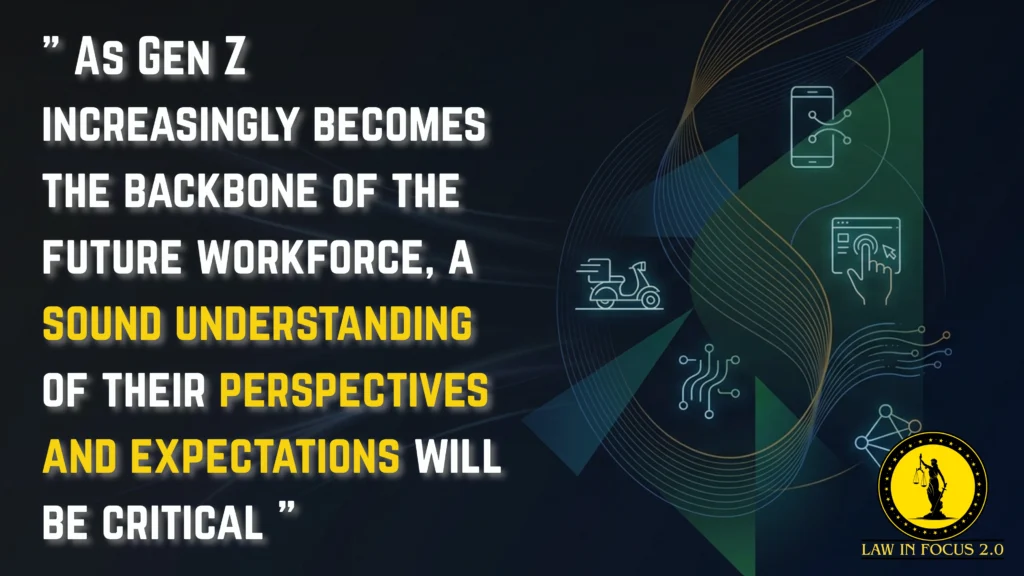
Justice Janak De Silva outlined five key principles for future reform: dignity, flexibility, fairness, simplicity and adaptability. As the symposium chairperson Manoli Jinadasa noted, “As Gen Z increasingly becomes the backbone of the future workforce, a sound understanding of their perspectives and expectations will be critical”.
The question is not whether Sri Lanka should modernise its labour laws, but whether it will do so before the next generation of workers decides their future lies elsewhere entirely.
Written By: –

Thisakya Kavindi
(Faculty of Commerce and Management Studies)
(University of Kelaniya)
Designed By: –

Rtr. Sanidu Karunarathne
( Senior Blog Team Member 2026-27)