When Reading Isn’t Seen, but Deeply Felt
Let’s try a small experiment, Close your eyes. Reach out your fingers. Now imagine reading a love letter, a legal document, a math equation, or even a spicy group chat message without seeing a single letter.
Challenging? Absolutely. Impossible? Not at all.
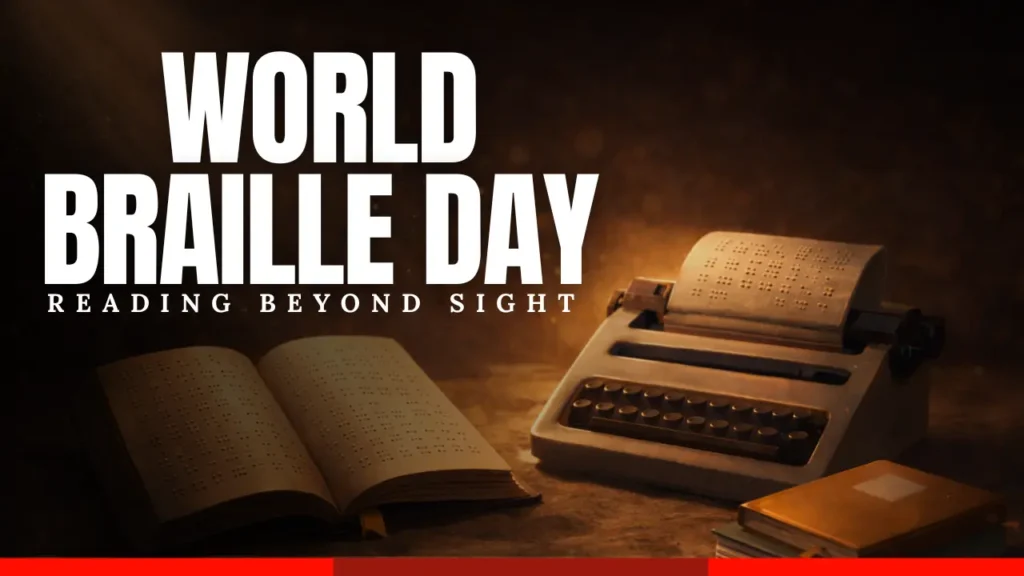
For millions of people across the world, reading has never been about eyesight. It has always been about touch, patience, memory, and independence. And that’s exactly what we celebrate every year on January 4th, World Braille Day, the birthday of Louis Braille, the man who turned six dots into a global language of empowerment.
The Quiet Genius of Six Dots.
At first glance, Braille looks… confusing.
Six tiny raised dots arranged in different patterns. No colours. No fonts. No bold or italics screaming for attention. Just dots. But don’t let the simplicity fool you.
Those dots can write poetry that makes you cry, formulas that solve complex equations, laws that shape societies, and stories that help someone escape reality for a while. From textbooks to novels, medicine labels to musical notes. Braille carries it all.
Literacy Is Power , Always Has Been
Here’s a truth we don’t talk about enough literacy equals freedom. Being able to read and write independently means you don’t have to ask someone what a sign says. You don’t have to trust someone else to read your exam paper or your bank statement. You don’t have to wonder if the medicine you’re taking is actually the right one. Braille is not a “special need.” It is a basic right. And World Braille Day exists to remind us that access to literacy should never depend on vision. Accessibility Is Not Extra, It’s Essential
Let’s clear something up. Ramps, Braille signs, accessible exam papers, inclusive education systems, these are not “favours.” They’re not charity projects. And they definitely don’t deserve slow claps as if someone has gone above and beyond. Accessibility is simply good design. Design that acknowledges diversity. Design that understands that not everyone experiences the world the same way and that’s okay.
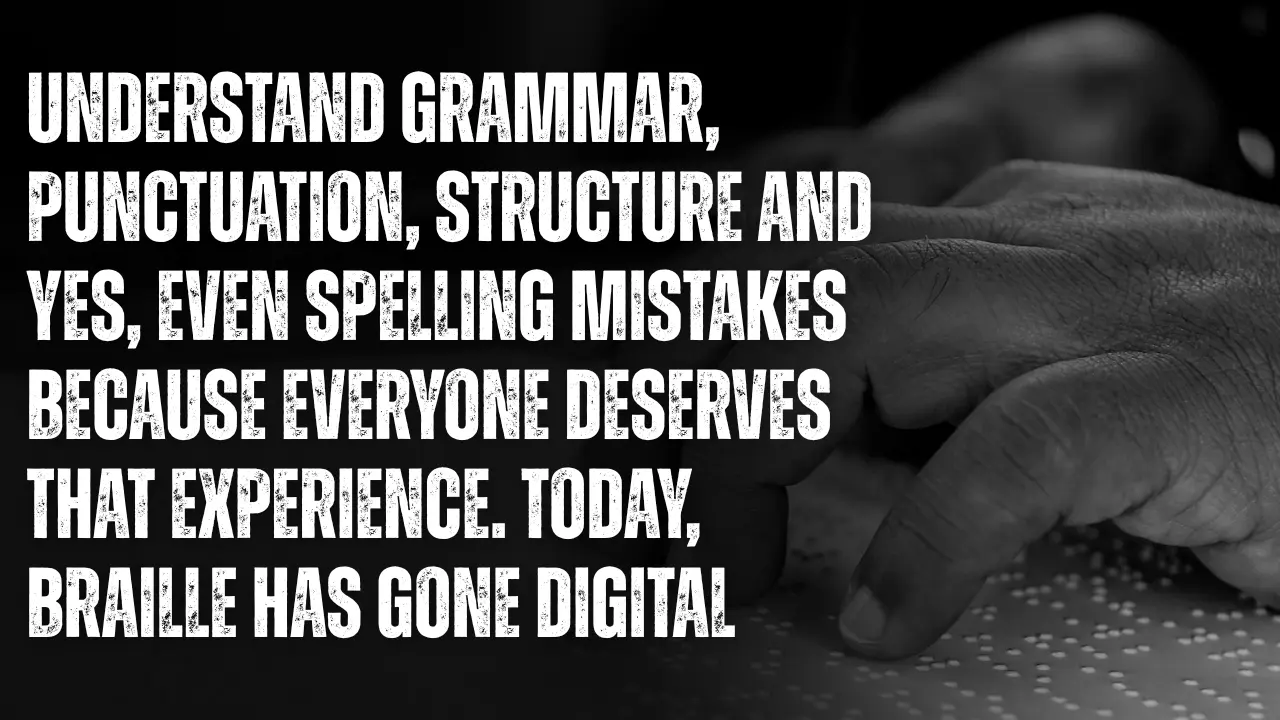
If a building is beautiful but unusable for someone, is it really well designed? If knowledge exists but isn’t accessible, is it truly knowledge? “But Isn’t Braille Outdated Now?” Ah yes. The famous question. In a world of audiobooks, screen readers, voice assistants, and AI that talks back, some people assume Braille has retired quietly into history. It hasn’t. Listening is not the same as reading. Audio cannot teach spelling the same way. It cannot replace the cognitive process of reading and writing. Braille allows users to understand grammar, punctuation, structure and yes, even spelling mistakes because everyone deserves that experience. Today, Braille has gone digital. Refreshable Braille displays, electronic note-takers, and smart devices have ensured that this tactile language continues to evolve with time.
Braille didn’t fall behind. It adapted. More Than a System , It’s a Voice World Braille Day is not just about honouring a writing system. It’s about recognizing People, their intelligence, independence, and right to equal participation in society. It’s about students who read textbooks with their fingertips. Professionals who sign contracts independently. Readers who fall in love with stories one dot at a time.
It’s about understanding that inclusion doesn’t mean making everyone the same it means making room for everyone. A Small Reminder for All of Us Today, when you see an elevator button with Braille, a sign with raised dots, or a book printed in Braille, don’t see it as something “extra.” See it as proof that the world can be built better when we choose to. Because sometimes, the most powerful knowledge isn’t written in bold letters.
Written By: –

Rtr. Kihansa Wickramasinghe
(Junior Blog Team Member 2025-26)